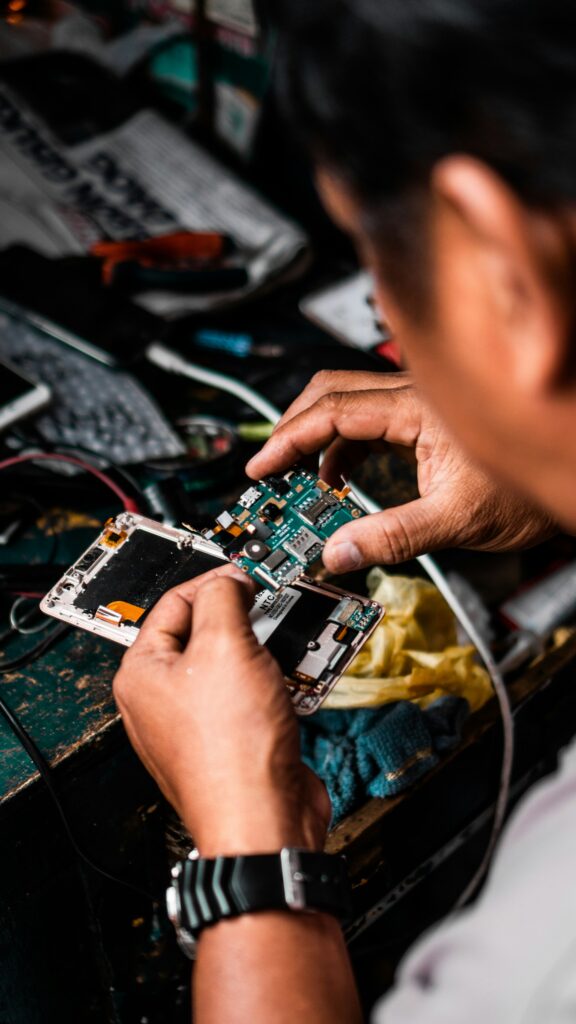
 Most repairs done in under an hour
 Free IT assessment

For most Ontario businesses under about 40 computers, managed IT gives you more skills, longer coverage and fewer single points of failure than hiring one in-house IT person, at a similar or lower total cost. An in-house hire starts to make sense when you need someone on site every day, and it works best paired with a managed IT team.
- Job Bank puts the Ontario median wage for a computer network technician at $35.71 an hour, before vacation pay, payroll costs, benefits, tools and training.
- One person cannot be on call around the clock, take holidays and cover security, backups, Microsoft 365 and networking all at once.
- Co-managed IT lets an internal IT person handle the day to day while a provider covers depth, tools and after hours.
- The right answer depends on headcount, how much is on site and how much downtime costs you.
What does an in-house IT person really cost in Ontario?
An in-house IT person costs a lot more than their salary. The wage is the biggest line, but you also pay vacation pay, employer payroll contributions, benefits, the tools they need to do the job, training, and the time it takes to hire and replace them.
Start with the wage. According to the Government of Canada’s Job Bank wage data for computer network technicians (NOC 22220), the Ontario median is $35.71 an hour, with a low of $19.00 and a high of $57.69. Job Bank shows the same figures for the London region.
At the median, a full-time year of about 2,080 hours works out to roughly $74,000 in wages. That is our arithmetic, not a Job Bank figure, and someone experienced enough to run a business network on their own will usually sit above the median.
The costs that sit on top of the wage
| Cost | What it covers | Easy to forget? |
|---|---|---|
| Vacation pay | Ontario’s minimum is two weeks off and 4 percent vacation pay in the first five years, then three weeks and 6 percent | Rarely forgotten, but the cover while they are away often is |
| Payroll contributions | Employer share of CPP and EI, plus WSIB where it applies | No |
| Benefits | Health and dental plans, RRSP matching if you offer it | No |
| Tools and licences | Remote monitoring, patching, endpoint security, backup software, a ticketing system, password vault | Yes. These are what an MSP already owns. |
| Training | Courses and certifications to keep up with Microsoft 365, security and networking changes | Yes |
| Hiring and turnover | Recruiting, onboarding, and the gap when they leave | Yes, until it happens |
The vacation rules come from the Ontario guide to the Employment Standards Act. The tools line is the one owners most often miss. A solo IT person without monitoring, patching and backup tools spends the day reacting instead of preventing.
What does managed IT cost by comparison?
Managed IT is usually priced as a flat monthly fee per computer, so the cost scales with your size instead of jumping by a full salary. As our business IT pricing page explains, managed IT for small and mid sized Ontario businesses commonly runs around $100 to $200 per computer per month, depending on what is included.
Here is what that range works out to over a year at different sizes. It is simple multiplication of the published range, before HST, and your exact number comes from a free assessment.
| Computers | At $100 per computer per month | At $200 per computer per month | Compared with one median-wage hire (about $74,000 in wages alone) |
|---|---|---|---|
| 5 | $6,000 a year | $12,000 a year | Managed IT is a fraction of the cost |
| 15 | $18,000 a year | $36,000 a year | Managed IT is well under half |
| 30 | $36,000 a year | $72,000 a year | Roughly level with wages only, before any hire overhead |
| 50 | $60,000 a year | $120,000 a year | An in-house hire becomes worth costing out, often alongside a provider |
What matters is what the monthly fee includes. With Ahsan Computers × Northline IT, every plan includes the help desk, monitoring, updates, endpoint protection, documentation and a 24/7 emergency line, and calls are never billed extra. Hardware, large projects and software licences are quoted separately.
What happens when your IT person is sick or on vacation?
With one in-house IT person, the honest answer is that IT waits. Ontario requires at least two weeks of vacation a year, people get sick, and nobody works nights and weekends forever. A server that fails on a Saturday or a phishing incident during their week off lands on whoever is in the office.
This is the biggest practical difference we see when businesses come to us after a long-time IT person leaves. The knowledge often left with them: admin passwords, how the firewall was set up, which backup actually runs. A managed IT team keeps that written down and shared across technicians, so no single person is the only one who knows.
Can one IT person cover everything a business needs?
Usually not well. Modern small business IT spans help desk, security, cloud, networking and backups, and these are different skill sets. A good generalist can handle many of them, but very few people are strong in all of them at once.
| Area | One in-house generalist | Managed IT team |
|---|---|---|
| Day to day help desk | Strong, and right down the hall | Strong, by phone, email and remote session, with on-site visits |
| Cybersecurity and threat response | Depends on the person | Dedicated tools and people who handle incidents regularly |
| Microsoft 365 administration | Usually fine for basics | Policies, conditional access and licensing handled as a routine |
| Networking, firewalls and Wi-Fi | Varies widely | Network specialists on the team |
| Backups and disaster recovery | Often set up once and rarely tested | Monitored daily, with restore tests |
| IT planning and roadmaps | Possible if they have time | Built into the service |
| After hours and holidays | Not covered without paying overtime | Emergency line around the clock |
The Canadian Centre for Cyber Security’s baseline cyber security controls for small and medium organizations is a good reality check. It covers patching, backups, strong authentication, secure configuration and more. Ask whether one person has the time to keep all of it in place while also fixing printers and setting up new staff.
When is hiring in-house IT the better choice?
In-house IT is the better choice when your business needs a person physically on site every working day, or has systems specialised enough that knowing them deeply matters more than breadth.
- Lots of hands-on work. Warehouses, clinics, labs and plants with a steady stream of desk-side requests, label printers, scanners and floor devices.
- Specialised in-house software. Custom line of business systems that need someone who knows them inside out.
- Larger headcount. Somewhere past 40 to 50 computers, a full-time person is busy enough to justify the salary.
- Culture and speed. Some teams simply work better with a familiar face down the hall.
Even then, we rarely see a lone IT person succeed without backup. Which is where co-managed IT comes in.
When does managed IT make more sense?
Managed IT makes more sense when you are too small to keep a full-time IT person busy, or when you need more skills and coverage than one person can provide. For most businesses with 3 to 40 computers, that is the reality.
- You want predictable monthly costs instead of salary, overtime and surprise projects.
- You have cyber insurance or client requirements that call for documented security controls.
- You have more than one location, such as offices in London and Toronto.
- You cannot afford for IT to stop when one person is away.
- You would rather your office manager stopped being the accidental IT department.
If you want to see what a provider actually does month to month, our guide on what a managed IT service provider actually does walks through it. For the full service, see managed IT services.
Can you have both? How co-managed IT works
Yes. Co-managed IT pairs your internal IT person with a managed IT team, so you keep the on-site knowledge and add the depth, tools and after hours cover around them.
In a typical split, the internal person handles desk-side requests, new staff setups and the business’s own software. The provider runs monitoring, patching, security tools, backups and escalations, and covers vacations and nights. Your IT person gets colleagues to call instead of being on their own. You can read more on our co-managed IT page.
How do you decide between managed IT and an in-house hire?
Decide by working through your size, on-site needs and risk in order. Most businesses get a clear answer by step four.
- Count devices and users. Include laptops, desktops, servers and anyone who logs in remotely.
- Estimate the hands-on work. How many requests a week genuinely need someone standing at the desk or the device?
- Price the full in-house cost. Wage, vacation pay, payroll contributions, benefits, tools, training and cover for time off.
- Get a managed IT quote for the same scope. Make sure security, backups and after hours are included so the comparison is fair.
- Ask what an outage costs you. If a lost day is expensive, coverage and depth matter more than the monthly figure.
- Check your requirements. Cyber insurance forms, client security questionnaires and privacy rules all need documented controls.
- Choose, then plan the handover. Whichever way you go, get passwords, documentation and admin access in order first.
A free IT assessment covers steps one, four and six for you, and gives you a written number to compare.
What should you check before signing with a provider?
Check scope, response, ownership and the exit before you sign. A good managed IT agreement is clear about what is included and what happens if you leave.
- Scope. Which devices, users, sites and services are covered, and what is billed separately.
- Response. How you reach the help desk and what happens after hours.
- Ownership. You should own your Microsoft 365 tenant, domain and admin accounts, not the provider.
- Documentation. Ask to see what they will document and how you get a copy.
- Leaving. Notice period, and how passwords and documentation are handed back.
Our plans run month to month with no contract, so the agreement has to earn its keep every month.
Quick answers
Does managed IT cost less than an IT employee?
For most businesses under about 30 to 40 computers, yes, once you add vacation pay, payroll costs, benefits and tools to the salary. Above that it is closer, and many larger offices use both.
Can a managed IT provider work on site?
Yes. Most work is done remotely because it is faster, but technicians visit for hardware, network and setup jobs. We serve London, Toronto, Mississauga, Markham and across Ontario.
Will we lose control of our systems with an MSP?
You should not. You keep ownership of your accounts and data, and a good provider gives you documentation and admin access you can always reach.
What if our current IT person is leaving?
Start the handover before their last day. Collect admin passwords, licence details and network notes, and bring in a provider early so nothing is lost in the gap.
Not sure which model fits your business?
Book a free assessment and we will look at your setup, then give you a written monthly number to compare with an in-house hire. Our team works from 546 Boler Rd in London, Ontario and across the province.
Need a full team instead of one person? See our outsourced IT department service.