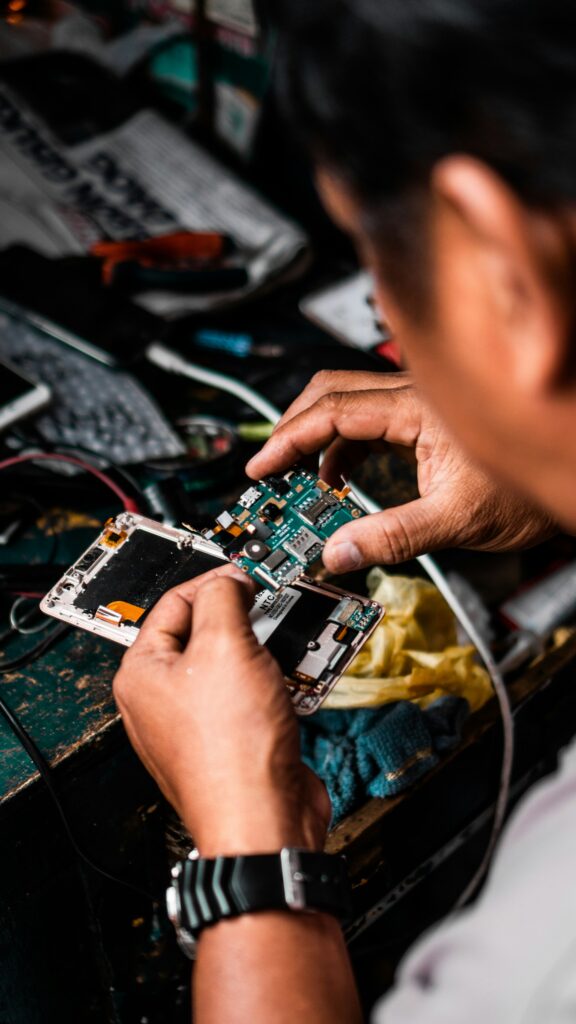
 Most repairs done in under an hour
 Free IT assessment
 Talk to a real person

Consumer routers are built for a few devices in a home. Offices need several ceiling mounted access points, wired back to the network, with proper roaming and a separate guest network. Wi-Fi 6 is fine for most offices today, Wi-Fi 6E adds the less crowded 6 GHz band, and Wi-Fi 7 adds wider channels and multi link operation for the highest speeds.
- More access points at lower power beats one strong router.
- Wire access points back to the switch, do not mesh them wirelessly.
- Separate guest Wi-Fi from staff and POS.
- A site survey tells you exactly how many you need.
Why consumer routers fail in offices
- They are designed for a handful of devices, not dozens of laptops and phones.
- One unit cannot cover several rooms, walls and floors.
- They do not hand calls over smoothly between units.
- Guest and staff traffic share one network.
- Management, logging and updates are limited.
Wi-Fi 6, 6E and 7 compared
| Wi-Fi 6 | Wi-Fi 6E | Wi-Fi 7 | |
|---|---|---|---|
| Bands | 2.4 and 5 GHz | Adds 6 GHz | 2.4, 5 and 6 GHz |
| Widest channel | 160 MHz | 160 MHz | 320 MHz |
| Theoretical max speed | 9.6 Gbps | 9.6 Gbps | Up to about 46 Gbps |
| Key feature | Efficiency with many devices | Clean 6 GHz spectrum | Multi link operation |
| Best for | Most offices today | Busy buildings | New installs, heavy use |
How many access points do you need?
It depends on floor area, wall materials, ceiling height and how many devices connect. As a rough guide, many offices need one access point per several meeting rooms or open plan zones, but warehouses and buildings with concrete or metal walls need more. A survey removes the guesswork.
Design basics that matter
- Survey the space. Measure coverage and interference before installing.
- Mount access points on the ceiling. Central, clear of metal and ducts.
- Wire every access point. Powered over Ethernet from a PoE switch.
- Plan channels. So neighbouring access points do not interfere.
- Separate networks. Staff, guests, POS and cameras on their own segments.
Warehouses, retail and high ceilings
Metal racking and stock absorb and reflect Wi-Fi. High ceilings spread signal thin at floor level. These spaces need access points placed for the racking layout, sometimes with directional antennas, and testing at the height people actually use devices.
Fixing the Wi-Fi you already have
- Move access points from closets and corners to ceilings.
- Replace wireless mesh links with cabled backhaul.
- Turn down power on overlapping access points.
- Split guests onto their own network.
- Update firmware and remove old 2.4 GHz only devices where possible.
Quick answers
Is Wi-Fi 7 worth it now?
For new installs, often yes. For existing offices, Wi-Fi 6 or 6E may be plenty.
Can we use mesh Wi-Fi?
Wired backhaul is far more reliable. Wireless mesh is a last resort.
Why do calls drop as I walk around?
Access points are not handing over properly. Roaming settings and placement fix it.
Do you do Wi-Fi surveys?
Yes, before every business Wi-Fi install.
Wi-Fi dropping in some rooms?
We survey your space, design proper coverage and install wired access points that hold through a call.